
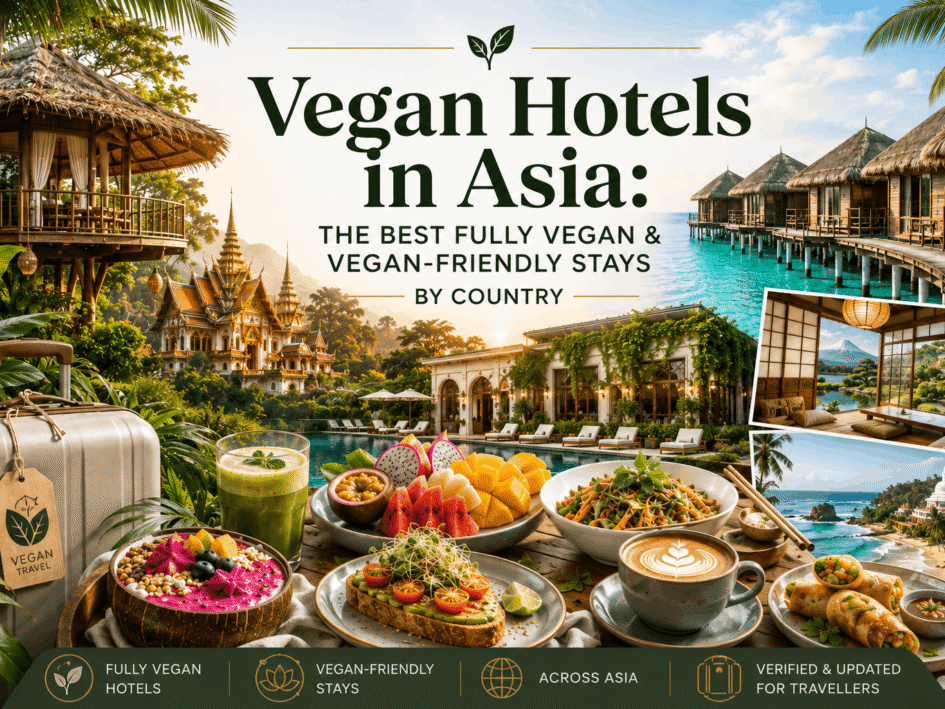
Ask a vegan traveller about hotel breakfasts in Asia five years ago and you'd probably get a wince. A sad side salad standing in for a main course, buffet trays built entirely around eggs and bacon, staff who mean well but genuinely don't know what "vegan" means. That's shifted faster than most people realise, and not just at the backpacker end. Fully plant-based hotels now operate in Thailand, Bali, Sri Lanka and Japan, while mainstream luxury groups from Six Senses to Soneva have built entire restaurant concepts around vegan tasting menus.
This guide runs country by country, split into two categories that get blurred together constantly online: hotels that are fully vegan, meaning nothing in the kitchen comes from an animal, and hotels that are vegan-friendly, meaning they run a serious plant-based menu inside an otherwise mixed-diet property. Both are worth booking. They're just not the same thing, and knowing which one you're getting matters if you're travelling with a non-vegan partner, or if you specifically want a kitchen you don't have to interrogate at every meal.
Every property below was checked against 2025-2026 reviews, live booking listings or the hotel's own channels. A handful of once-popular write-ups didn't make the cut because nobody could confirm they're still open, still vegan, or still trading under the same name.
What "fully vegan" actually means, versus "vegan-friendly"
A fully vegan hotel serves zero animal products across its menu; some go further and use only cruelty-free amenities and vegan linens too. A vegan-friendly hotel has a genuine, well-executed plant-based menu, sometimes even a dedicated vegan restaurant, but sits inside a property that also serves meat, dairy and eggs to other guests.
The line blurs constantly in existing round-ups. Fivelements in Bali gets filed as "100% vegan" almost everywhere, and its dining room mostly is, but a few dishes use honey. Some booking platforms describe fully vegan kitchens as merely "vegetarian." Below, we've labelled a hotel as fully vegan only where a source states outright that the kitchen is 100% plant-based. Where that's fuzzy, we've said so.
Thailand
Thailand has more fully vegan hotels than anywhere else in Asia, and Chiang Mai is where most of them live.
Fully vegan hotels in Thailand
Away Chiang Mai Thapae Resort, a 39-room boutique property inside the Old City near Tha Phae Gate, keeps to strict Thai Buddhist practice: no meat, no alcohol, anywhere on site. Its restaurant, Moreganic, runs a fully vegan buffet breakfast that stretches from Thai dishes to croissants and a proper salad bar, and a second in-house outlet called Seiva Brunchery has just opened alongside it. The Michelin Guide awarded it a Michelin Key, noting that "in strict Thai Buddhist style, neither meat nor alcohol are served here," and Thailand's own sustainable-tourism rating system gives it five stars. Recent Expedia reviews sit at 9.4 out of 10 across more than 300 stays, and rooms run roughly $64 to $88 a night, which for a Michelin-recognised property is genuinely good value.
A short walk away, Green Tiger House claims the title of Chiang Mai's first fully vegan hotel. It's a looser, more social 32-room guesthouse with a plunge pool and a rooftop lounge looking out toward Doi Suthep, and its café, Reform Kafé, does Khao Soi and Pad Thai alongside Western comfort food, with toast, tea and coffee available around the clock. Rooms and dorms start from around $50.
In Bangkok, the property that keeps coming up in Airbnb reviews and Instagram threads rather than mainstream guides is Na Vayla PaPlern, a small B&B in the quiet Bang Khun Non canal district. It's fully vegan downstairs, the standout dish by most accounts is a vegan tonkatsu-style ramen, and it's a five-minute walk from an MRT station for around $32 a night. Over on Koh Phangan, Wonderland Healing Center runs a jungle detox-and-yoga retreat model with three daily vegan buffets and a juice bar, no MSG or refined sugar involved.
Vegan-friendly hotels in Thailand
Outside the fully vegan tier, Thailand's vegan-friendly luxury scene runs deep. The Sanctuary Thailand on Koh Phangan's Haad Tien Bay leans heavily plant-based without being exclusively so. Soneva Kiri, on the private island of Koh Kood, carries the Soneva group's well-known plant-forward dining philosophy. And Amanpuri in Phuket, an ultra-luxury Aman property, made Fodor's 2025 best-hotels list partly on the strength of how well it handles vegan requests.
Indonesia (Bali)
Bali's fully vegan hotels tend to be small, design-led and a little out of the way, which is part of the appeal.
Fully vegan hotels in Bali
Fivelements Retreat, on the Ayung River near Ubud, is the best known: 20 eco-luxury suites, some with private bath houses, built around a wellness-sanctuary model that's been running since 2010. Its Sakti Dining Room serves an almost entirely raw, plant-based menu, though a few dishes do use honey, worth knowing if you're strict.
Gdas Bali Health and Wellness Resort, an adults-only property in Mas near Ubud, opened more recently and has picked up over 200 verified reviews on Booking.com, several from non-vegan guests who were won over by the food. Its Tangi Restaurant runs entirely plant-based, including raw options, with dishes like a red curry eggplant and a mushroom turmeric rice that get mentioned often enough to be worth trying.
Further west, Lost Lindenberg in the sleepy town of Pekutatan is the most architecturally striking of the three: eight suites built into elevated wooden treehouses, solar-powered, with a permaculture garden feeding a communal-table vegan dinner. It's part of Small Luxury Hotels of the World and made Tatler's Best list for 2026, though it's a genuine two-hour drive from the airport, and some booking platforms still list its food as simply "vegetarian" rather than vegan, so it's worth confirming directly if that distinction matters to you.
For something cheaper, Serenity Eco Guesthouse in Canggu was Bali's first hotel to earn Vegan Hospitality certification, the accommodation-specific mark that keeps coming up across this guide (more on what that actually means further down). It sits next to its own restaurant, Alkaline, which sources most ingredients within about 50 kilometres and serves detox juices, burgers and Balinese dishes for roughly $30 to $70 a night.
Vegan-friendly hotels in Bali
Puri Ganesha Villas in northwest Bali is a small beachfront property run by Diana von Cranach, a well-regarded raw and plant-based chef who caters specifically to vegan guests. The Ubud Village Resort & Spa, BeingSattvaa, Komune Resort in Keramas and Kalapa Resort in Canggu all run extensive vegan menu sections alongside their regular dining, and each shows up repeatedly in vegan-travel write-ups for good reason.
Sri Lanka
Sri Lanka does more with less than almost anywhere else on this list.
Fully vegan hotels in Sri Lanka
The Slow, a bohemian beachfront hotel in Mirissa about 150 metres from the sand, has been fully vegan since it opened in 2021, and its Booking.com page has over 830 reviews, most of them glowing. Guests mention the manager, Sam, by name often enough that it's clearly part of the draw. There's a separate, lower-rated Tripadvisor listing for the same property that looks like an old duplicate; Booking.com and Instagram are the more reliable current sources. Rooms run $50 to $110 depending on season, and it books out.
Green Peace Inn is smaller and quieter, a yoga-and-surf retreat with a fully vegan, locally sourced menu that turned up through the Ecotels vegan-accommodation directory rather than mainstream press.
Vegan-friendly hotels in Sri Lanka
Sri Lanka's vegan-friendly luxury tier is genuinely strong, largely thanks to the Jetwing group. Jetwing Yala runs a full plant-based culinary programme near Yala National Park, including a proper vegan take on Sri Lankan rice and curry. Jetwing Lighthouse, a Geoffrey Bawa-designed hotel in Galle, and Jetwing Ayurveda Pavilions in Negombo, a near-vegetarian Ayurvedic resort with doctor-guided menus, both come up repeatedly as standouts. Rukgala Retreat near Victoria Lake runs an all-meals-included model where the largely meat-free Sri Lankan menu suits vegans without much adjustment needed.
Japan
Japan's fully vegan lodging is real but small, and it doesn't look like a hotel in the way Thailand's or Bali's do. Think tatami-floored minshuku, temple lodgings and the occasional mountain ryokan rather than anything with more than a handful of rooms.
Fully vegan hotels in Japan
Vegan Minshuku Sanbiki Neko in Kyoto is exactly that: a fully vegan Japanese-style B&B with futon bedding, shoji screens, and a cooked Japanese breakfast made from local seasonal produce, served communally with resident cats wandering through. In the Shizuoka mountains, Açai Vegan Café & Ryokan does a similarly small-scale version, with a well-reviewed vegan sushi set and traditional soaking tubs. In Tokyo's Asakusa district, Inn Oyado Matsumura is one of the very few properties in the entire city serving only vegan food, according to the community-run site isitveganjapan.com, which tracks this kind of thing closely because so few others do.
Vegan-friendly hotels in Japan
The temple lodgings on Mount Koya, known as shukubo, deserve a specific mention. Places like Eko-in serve shojin ryori, the Buddhist vegan cooking tradition that's been plant-only for centuries by design, not as a modern accommodation trend. Among the bigger ryokan chains, Hoshino Resorts KAI Kinugawa is the one most consistently documented as offering a full vegan kaiseki course, along with feather-free bedding, if you give them 7 to 14 days' notice. Nanten-en, an onsen ryokan near Osaka, will also prepare an all-vegan multi-course meal on request.
Vietnam
Vietnam doesn't have a standout fully vegan hotel yet, at least not one that surfaced anywhere in our research, but the vegan-friendly luxury tier is solid and growing.
Vegan-friendly hotels in Vietnam
TIA Wellness Resort in Da Nang, previously known as Fusion Maia Danang before a rebrand, does spa-inclusive beachfront villas with a genuinely strong plant-based menu. Namia River Retreat in Hoi An opened in 2024 and leans into creative plant-based cooking as part of its wellness positioning. In Ho Chi Minh City, The Reverie Saigon runs vegan breakfasts, a vegan Italian tasting menu and plant-based canapés at a level of opulence you wouldn't necessarily expect. Six Senses Con Dao, on a remote island, does both Western and traditional Vietnamese vegan dishes, and Anantara Hoi An Resort has built something of a reputation for its cashew-cheese vegan pizza alongside a wider plant-based menu.
Taiwan
Taipei was ranked the most vegan-friendly city in Asia in PETA Asia's first "Top 10 Vegan-Friendly Cities" list, and the hotel scene backs that up. The food culture behind that ranking is broad enough to run from plant-based versions of Western comfort staples right through to the island's own vegan take on pineapple cake, which says something about how mainstream plant-based eating has become there.
Fully vegan hotels in Taiwan
Loving Hut Paradise Island is a small beachfront bed and breakfast, part of the international Loving Hut vegan network, with a garden, hot tub and bikes to borrow.
Vegan-friendly hotels in Taiwan
Grand Hyatt Taipei, an 850-plus-room property by Taipei 101, uses 100% vegan bathroom amenities and offers vegan options across all ten of its food and beverage outlets. Regent Taipei runs vegan set menus across its restaurants, including in its teppanyaki experience, and both Mandarin Oriental Taipei and Le Méridien Taipei show up regularly on vegan-friendly luxury lists too.
Maldives
The Maldives doesn't really do fully vegan resorts, and there's a structural reason for that: the ultra-luxury all-inclusive model there is built around one restaurant serving many different diets at once, so a property going 100% vegan would mean turning away most of its own guests. What a handful of resorts have done instead is build a genuinely standalone vegan restaurant inside an otherwise mixed-diet property.
Vegan-friendly hotels in the Maldives
Soneva Fushi's restaurant Shades of Green is, by Vegan Food Quest's account, the first fully plant-based restaurant in the Maldives, run by Danish chef Carsten Kyster, formerly of Jamie Oliver's River Café, with a rotating six-course menu built around a different colour each night, so one sitting might run entirely orange-hued dishes and the next entirely green. The resort also runs a vegan pillow menu and refillable, cruelty-free amenities. Its sister property Soneva Jani has So Wild by Diana von Cranach, an entirely vegan raw-food restaurant, and Amilla Maldives is known specifically for the depth of its dedicated vegan menu rather than any single standout dish.
India
India's vegan hotel scene splits into two very different things, and the split matters more here than in most countries because Indian vegetarian cooking leans heavily on dairy: ghee, paneer and yoghurt turn up constantly in food labelled simply "veg," which isn't automatically vegan even when it looks meat-free.
Fully vegan hotels in India
Bean Me Up in Anjuna, Goa, is the clearest example: a fully vegan restaurant-and-guesthouse under mango and jackfruit trees, about a 16-minute walk from Ozran Beach, with themed rooms from roughly $25 to $50 a night.
Vegan-friendly and easily-veganised stays in India
Beyond that one confirmed property sits a much larger pure-vegetarian hotel segment, chains like The Byke across Goa, Matheran and Kovalam, which aren't strictly vegan but are easy to adapt given how deep India's plant-based cooking already runs once you know to ask for it dairy-free. Rishikesh, known as the yoga capital, is worth a specific mention as a base with an unusually high concentration of vegan-friendly stays and restaurants, largely thanks to the international yoga and wellness crowd that's been requesting plant-based food there for years.
Cambodia
Cambodia's strongest vegan hotel is also its cheapest, which isn't always how this list works out.
Fully vegan hotels in Cambodia
Sundays Hotel & Vegan Café in Phnom Penh is a small hotel and café where the owner, Darren, has a bit of a reputation in the vegan travel community for personally helping guests plan their itineraries.
Vegan-friendly hotels in Cambodia
At the other end of the market, Six Senses Krabey Island runs its "Eat With Six Senses" programme with vegan versions of Khmer staples like nom banh chok, and Phum Baitang in Siem Reap does memorable plant-based Khmer dining inside a luxury stilted-villa resort. Hyatt Regency Phnom Penh, a modern five-star, also runs a dedicated vegan menu built around what it calls future foods. Between Sundays at one end and Six Senses at the other, Cambodia covers more of the price spectrum than its small number of properties would suggest.
Malaysia
Malaysia's clearest benchmark is the Sunway group, which now runs three hotels certified by Vegan Hospitality, including Sunway Banjaran. It's the same certification body behind Bali's Serenity Eco Guesthouse, and having three certified properties under one group is unusual enough that Kuala Lumpur now regularly gets ranked among Asia's most vegan-friendly cities partly on the strength of it.
Singapore
Maxwell Reserve, Autograph Collection has a fully plant-based café called Cultivate Café, open daily from 11am to 9pm, tucked inside an otherwise conventional luxury hotel. Singapore came second, just behind Taipei, on PETA Asia's ranking of the region's most vegan-friendly cities, which judged cities on the depth of their vegan restaurant scenes rather than any single hotel.
The Philippines
The Philippines is where the industry-wide shift is most visible right now, more than at any single hotel. The Farm at San Benito in Batangas has long been the go-to wellness destination for vegan travellers, but the bigger story is happening at chain level. IHG's six Philippine properties, including Crowne Plaza Manila Galleria and Holiday Inn & Suites Makati, have committed to 30% plant-based menus by 2025. Ascott Limited is running a slower ramp across 17 properties, 20% by 2025 rising to 30% by 2027, and Okada Manila has set its own target of 30% by 2028. All three are working with the Lever Foundation on the shift. None of this is vegan hotel territory yet, but it's worth watching over the next couple of years, since a 30% plant-based menu is a meaningfully easier place to find a real meal than the token single salad most hotels still default to.
Vegan hotel certifications in Asia, explained
The one certification that comes up repeatedly across this guide is Vegan Hospitality, an accommodation-specific mark rather than a restaurant-only one, which is part of why it's worth learning to recognise. It was founded by Meredith Marin in 2019 and relaunched as a nonprofit in 2025 alongside co-founder Hayley Cooper, and it now trains and certifies hotels in more than 30 countries. Serenity Eco Guesthouse in Canggu was Bali's first hotel to earn it, and Malaysia's Sunway group now holds it across three properties, including Sunway Banjaran.
Worth knowing exactly what the certification does and doesn't promise: it's a vegan-friendly guest-services standard, independently audited and paired with staff training, rather than a guarantee that the entire kitchen is 100% plant-based. That's a real distinction and not just a technicality; a certified property is a strong signal that staff know what they're doing and the menu has been taken seriously, but it isn't the same claim as the "fully vegan" label used elsewhere in this guide. Still, it's a genuinely useful shortcut when you're trying to tell a marketing claim from a verified one.
It's worth separating that from the other credentials that show up in this guide, which matter but aren't vegan-specific. A Michelin Key, like the one Away Chiang Mai holds, is a quality mark from the Michelin Guide with no vegan criteria attached; Thailand's STAR sustainable-tourism rating measures environmental practice, not diet; and PETA Asia's city rankings score entire cities on their vegan restaurant scenes rather than certifying individual hotels. All three are useful trust signals, but none of them tell you whether the kitchen is actually vegan, which is exactly why the verification steps below still matter even at a well-reviewed, well-rated property.
How to actually confirm a hotel is vegan before you book
Booking platforms and hotel websites aren't always careful about the difference between "vegan" and "vegetarian," so it's worth doing a few checks before you commit, especially for anything billed as fully vegan.
Look for a live rate on real dates through Booking.com or Agoda rather than trusting an old listing. Check when the most recent review was left; anything older than about 12 months on a small independent property is worth a second look, since these places change hands and menus more often than big chains do. Check the property's Instagram for recent activity, not just a nice-looking feed from three years ago. And for anything built around a private villa or a shared communal dinner, like Harmony Hill near Ubud or Lost Lindenberg's communal table, email ahead and ask what "vegan" actually covers on their menu, because the scope varies more than the marketing suggests.
At vegan-friendly, rather than fully vegan, hotels, the standard advice from people who do this a lot is to notify the restaurant or F&B manager of your diet twice: once when you book, and again at check-in. For anywhere doing a set menu or kaiseki course, particularly in Japan, give them 7 to 14 days if you can. It's a small thing that makes a real difference to what actually turns up on your plate.
Vegan hotels in Asia, by country
| Country | Fully vegan hotels | Vegan-friendly / luxury hotels | Typical price band |
|---|---|---|---|
| Thailand | 4 (Away Chiang Mai, Green Tiger House, Na Vayla PaPlern, Wonderland Healing Center) | 3 (The Sanctuary, Soneva Kiri, Amanpuri) | Budget to luxury |
| Indonesia (Bali) | 4 (Fivelements, Gdas Bali, Lost Lindenberg, Serenity Eco Guesthouse) | 5 (Puri Ganesha, Ubud Village Resort, BeingSattvaa, Komune, Kalapa) | Budget to luxury |
| Sri Lanka | 2 (The Slow, Green Peace Inn) | 4 (Jetwing Yala, Jetwing Lighthouse, Jetwing Ayurveda Pavilions, Rukgala Retreat) | Budget to luxury |
| Japan | 3 (Vegan Minshuku Sanbiki Neko, Açai, Inn Oyado Matsumura) | 3 (Koyasan shukubo, Hoshino Resorts KAI Kinugawa, Nanten-en) | Mid-range |
| Vietnam | 0 confirmed | 5 (TIA Wellness, Namia River Retreat, The Reverie Saigon, Six Senses Con Dao, Anantara Hoi An) | Luxury |
| Taiwan | 1 (Loving Hut Paradise Island) | 4 (Grand Hyatt Taipei, Regent Taipei, Mandarin Oriental Taipei, Le Méridien Taipei) | Budget and luxury |
| Maldives | 0 confirmed | 3 (Soneva Fushi, Soneva Jani, Amilla Maldives) | Ultra-luxury |
| India | 1 (Bean Me Up) | Pure-veg chains (e.g. The Byke) plus the Rishikesh cluster | Budget to mid |
| Cambodia | 1 (Sundays Hotel & Vegan Café) | 3 (Six Senses Krabey Island, Phum Baitang, Hyatt Regency Phnom Penh) | Budget to luxury |
| Malaysia | 0 confirmed | 3 Vegan Hospitality-certified (Sunway group, inc. Sunway Banjaran) | Mid to luxury |
| Singapore | 0 confirmed | 1 (Maxwell Reserve) | Luxury |
| Philippines | 0 confirmed | The Farm at San Benito, plus chain-wide pledges (IHG, Ascott, Okada Manila) | Mid to luxury |
Quick picks by budget
| Budget | Where to stay |
|---|---|
| Under $50/night | Na Vayla PaPlern (Bangkok), Bean Me Up (Goa), Green Tiger House dorms (Chiang Mai) |
| $30-$90/night | Serenity Eco Guesthouse (Canggu), Sundays Hotel & Vegan Café (Phnom Penh), Away Chiang Mai |
| Mid-range | Wonderland Healing Center (Koh Phangan), Vegan Minshuku Sanbiki Neko (Kyoto), The Slow (Mirissa) |
| Luxury | Fivelements, Gdas Bali, Lost Lindenberg (Bali), Soneva Fushi and Soneva Jani (Maldives), TIA Wellness (Vietnam), Six Senses Krabey Island (Cambodia) |
Frequently Asked Questions
Are there fully vegan hotels in Asia?
Yes, though they're concentrated in a few countries. Thailand and Bali have the most established fully vegan hotels, including Away Chiang Mai and Fivelements, while Sri Lanka, Japan, Cambodia and India each have at least one confirmed fully vegan property, usually smaller and independently run.
Which Asian country is the most vegan-friendly for hotels?
Thailand has the highest concentration of fully vegan hotels, but Taiwan and Singapore rank highest citywide for vegan-friendliness, according to PETA Asia's rankings. For vegan-friendly luxury dining specifically, the Maldives and Vietnam both punch well above their weight.
What's the difference between a vegan hotel and a vegan-friendly hotel?
A fully vegan hotel serves no animal products anywhere on the menu. A vegan-friendly hotel runs a genuine plant-based menu, sometimes a dedicated vegan restaurant, inside a property that also serves non-vegan guests. Both can be excellent; they're just not interchangeable claims.
How far ahead should I tell a hotel I'm vegan?
At booking, and again at check-in. For set-menu or kaiseki-style dining, especially in Japan, aim for 7 to 14 days' notice so the kitchen can plan properly rather than improvise a plate of steamed vegetables.
A couple of things worth flagging before you finalise anything: prices throughout this guide are aggregator estimates and move around by season, so treat them as a starting point rather than a quote. And if a place you've read about elsewhere doesn't match what's here, check the current name; Fusion Maia Danang, for instance, is now TIA Wellness Resort, and a few older write-ups still use the old one.